The most common mistake we see on Reno hillside projects is treating the slope as an afterthought. A builder cuts into the hillside, assumes it will hold, and then spring runoff hits. The ground moves. There’s no quick fix at that point, just expensive emergency shoring and delays. Our lab runs slope stability analysis before the first excavator arrives. We drill, sample, and model the failure surface using real strength parameters from the site. In places like Somersett or ArrowCreek, where decomposed granite sits over claystone, the risk is real. We’ve seen designers combine our in-situ permeability data with slope models to understand how water migrates through the weathered zone. That connection is critical here. Reno’s annual precipitation is only about 7.5 inches, but when it comes, it comes fast and destabilizes cut faces. A thorough analysis also ties directly into foundation design, so we often pair it with footings evaluation to ensure the whole hillside structure works together from the base up.
In Reno, a 2:1 cut slope in decomposed granite can stand for years until one wet winter changes the pore pressure and drops the factor of safety below 1.0.
Service characteristics in Reno
Demonstration video
Typical technical challenges in Reno
The slope conditions in the Caughlin Ranch area differ sharply from those near Stead. Caughlin Ranch sits on weathered granitic terrain with shallow groundwater perched in the fractures. Stead has thick lacustrine clays that creep slowly but relentlessly. A slope design that works in one location will fail in the other. The risk multiplies when you consider the seismic hazard. Reno is located in a zone of high seismicity, with the Mt. Rose fault system just west of the city and the Warm Springs Valley fault to the north. A slope stability analysis that ignores seismic loading is incomplete. We model the pseudostatic coefficient and, on critical projects, run a full Newmark displacement analysis to estimate permanent deformation during the design earthquake. Homeowners on the western slopes sometimes ask why their neighbor’s lot required a grouting program while theirs didn’t. The answer is always in the subsurface data and the slope model output, not in a generic rule of thumb.
Our services
Our slope stability analysis work in Reno covers three main areas. Each one addresses a specific phase of the project lifecycle.
Natural Slope and Cut Stability
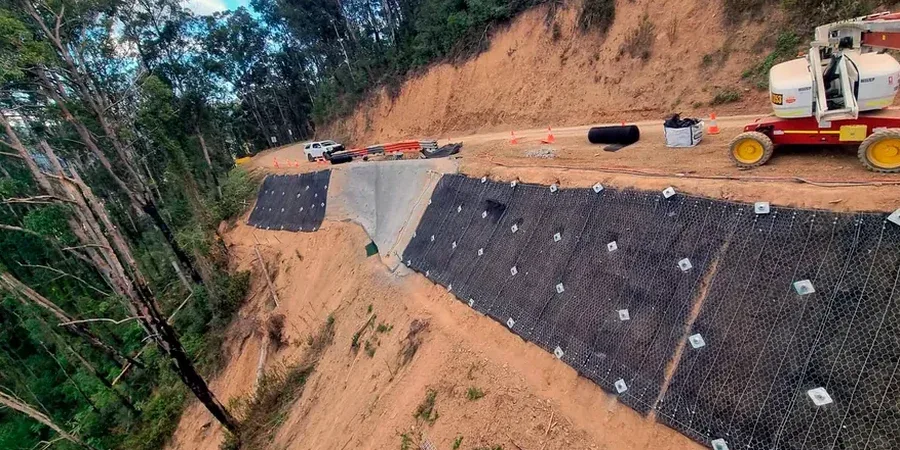
We analyze existing natural slopes and proposed cut slopes for residential subdivisions, commercial pads, and roadway expansions. The analysis includes field mapping, subsurface drilling, lab testing of shear strength, and computer modeling of the critical failure surface under both dry and saturated conditions.
Embankment and Fill Slope Design
We evaluate compacted fill slopes for structural support and global stability. This involves specifying compaction requirements, testing fill material gradation and strength, and modeling the interface between fill and native ground to prevent deep-seated failures.
Common questions
What triggers a slope failure in the Reno area?
Water is the primary trigger. Intense spring snowmelt or heavy rain saturates the soil, reducing effective stress and shear strength. Seismic shaking is the second major trigger. Construction activity like undercutting the toe of a slope without proper support also causes failures.
What does a slope stability analysis cost in Reno?
The cost typically ranges from US$1,100 to US$3,880 depending on the slope height, complexity of the subsurface conditions, and whether seismic deformation analysis is required. A simple cut slope on a single-family lot falls at the lower end; a tall commercial embankment with complex stratigraphy and FEM modeling falls at the higher end.
How long does the analysis take?
A standard analysis with drilling, lab testing, and reporting usually takes 3 to 4 weeks. The lab testing itself requires 7 to 10 days for shear strength specimens to be prepared, saturated, and sheared at the correct rate. Expedited turnaround is possible if we coordinate the drilling and lab schedule early.