The 2018 International Building Code, as adopted by the City of Reno, leaves no room for guesswork when it comes to earthwork. At 4,500 feet of elevation in the high desert, the Truckee Meadows presents fill soils that range from decomposed granite to silty wash deposits, and lift thickness can make or break a slab. We run ASTM D1556 field density tests because a nuclear gauge alone cannot resolve disputes when coarse gravel skews the reading. Whether your site sits on the alluvial fans near Stead or the tighter lots along the Truckee River corridor, the plate load test becomes the logical next step once compaction passes at grade, giving you bearing capacity numbers the structural engineer can actually use. Our technicians have logged hundreds of tests on Reno job sites and understand how morning frost in November or rapid afternoon drying in July shifts moisture-density relationships on site.
A passing sand cone test is the cheapest insurance policy a Reno builder can buy against differential settlement in expansive or poorly compacted fill.
Service characteristics in Reno
Typical technical challenges in Reno
Reno's climate swings from single-digit winter nights to summer afternoons that crack 100°F, and both extremes punish poorly compacted fill. Freeze-thaw cycling in the upper 18 inches of the soil column can heave a slab edge 3/8 inch or more if the moisture content was high at placement and density fell below 92 percent. Conversely, the arid summers wick moisture out of exposed fill so fast that a lift can go from optimum to dust-dry between the water truck and the roller, leaving a crust that looks firm but hides loose material underneath. Skipping a sand cone test in those conditions means the structural slab becomes the proof test, and concrete is a very expensive way to discover a soft spot. The geotechnical report for any Reno project should specify both the target density and the allowable moisture range, and our field crew enforces those numbers with every cone hole.
Our services
Our field density program in Reno covers the full sequence from subgrade proof-rolling to final acceptance, with documentation that satisfies both the City of Reno Building Department and the project geotechnical engineer.
Compaction verification for structural fill and slabs
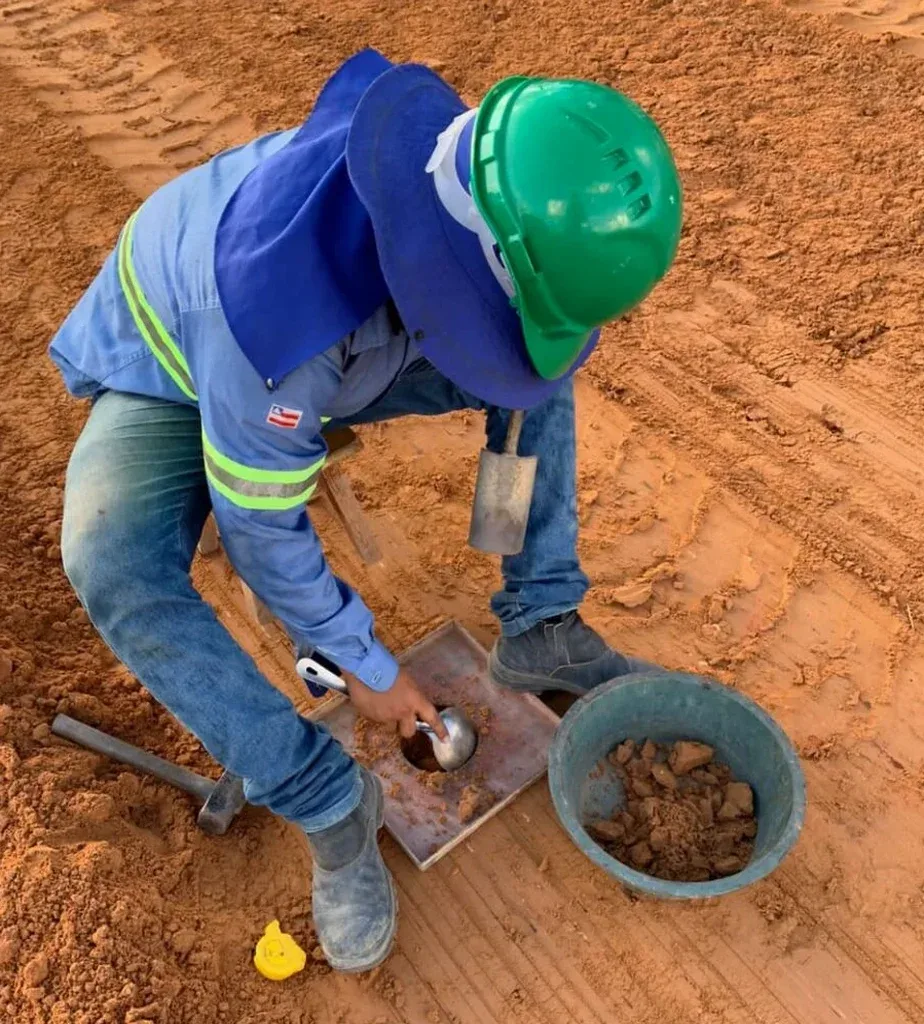
We run ASTM D1556 sand cone tests on building pads, retaining wall backfill, and slab subgrades, issuing a stamped field report with density, moisture, and percent compaction calculated against the lab proctor curve within 24 hours.
Utility trench and pavement section testing
From sewer laterals in the Old Southwest to water main tie-ins under arterial roads, we test trench backfill lifts at the frequency the City of Reno Public Works standard drawings require, helping contractors close out permits without re-excavation.
Common questions
How much does a field density test cost in Reno?
A single ASTM D1556 sand cone test typically runs between US$100 and US$150, depending on site location within the Truckee Meadows, number of tests scheduled per mobilization, and whether the proctor curve is already on file or needs to be developed in the lab. We provide a firm quote before dispatch so there are no surprises.
How many sand cone tests does the City of Reno require?
The frequency follows IBC Table 1705.6, which generally calls for one field density test per lift per 2,500 square feet of building pad, with additional tests at deeper lifts and in utility trenches per the city's standard specifications. The geotechnical engineer of record can adjust that number based on observed conditions.
Can the sand cone method be used on gravelly soils common around Reno?
Yes, and it is often preferred over a nuclear gauge in coarse granular fills where larger particles would distort a gauge reading. The test hole diameter can be enlarged for gravels up to 1.5 inches, and the technician selects the appropriate calibrated sand to avoid bridging and ensure the excavated volume is measured accurately.
What happens if my fill fails the density test?
We mark the failed location, note the percent compaction and moisture content, and the contractor reworks the lift, typically by scarifying, adjusting moisture, and recompacting with the appropriate roller. We return for retest at no additional mobilization charge when scheduled with the same crew, and we stay on site until the lift passes and can be covered.