Reno sits atop the Truckee Meadows basin, where subsurface conditions shift from coarse alluvial fan deposits near the Sierra foothills to fine-grained lacustrine sediments in the valley center. Groundwater can appear as shallow as 10 feet in lower reaches, complicating excavation support. Designing active and passive anchors here means confronting highly variable stratigraphy: a single site can alternate between clean sands, stiff silts, and weathered granitic cobbles within 30 vertical feet. We integrate CPT soundings early in the investigation to map these transitions continuously, then pair the data with laboratory shear strength tests. The result is an anchor bond zone positioned where the ground actually can carry load, not where the nearest boring happened to show a stiff layer. For projects with limited headroom or access constraints, combining anchors with a retaining wall analysis ensures the global stability check accounts for the full soil-structure interaction.
In the Truckee Meadows basin, anchor bond length succeeds or fails on where you place the grout body relative to the water table and the transition from alluvial fan to lacustrine clay.
Service characteristics in Reno
Typical technical challenges in Reno
At 4,500 feet elevation on the eastern slope of the Sierra Nevada, Reno sits in a high-hazard seismic zone where peak ground accelerations can exceed 0.8g on soft basin sites. An anchor system designed without a site-specific ground response analysis risks bond zone failure if the free length intersects a liquefiable lens. The 2008 Mogul earthquake sequence, though moderate at M5.0, reminded the local engineering community that shallow crustal events can focus energy into the basin fill. We routinely run Plaxis 2D models coupling anchor elements with Mohr-Coulomb or Hardening Soil parameters derived from consolidated-undrained triaxial tests on undisturbed samples. If the anchor head lands within the influence zone of an adjacent structure, we specify staged lock-off sequences to keep lateral wall movement under 0.5 inches, protecting existing utilities and neighboring foundations.
Our services
Anchor design in Reno requires more than selecting a bond stress from a generic table. Our scope covers investigation through construction support, always tied to the specific basin stratigraphy and groundwater conditions encountered at the site.
Active Anchor Systems
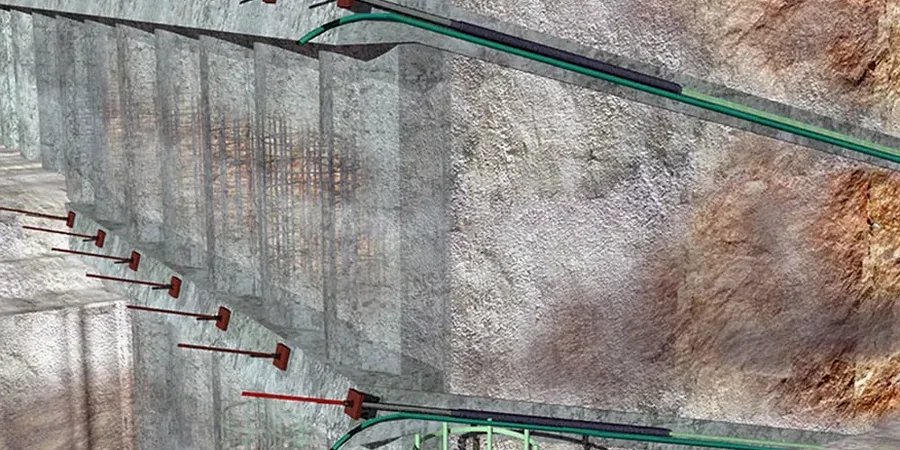
Pre-stressed tiebacks for permanent retaining walls and deep excavations. We design the unbonded length, bonded length, and lock-off load to limit movement in sensitive urban settings. Proof testing and lift-off checks confirm load transfer before the shoring system advances.
Passive Anchor and Soil Nail Walls
Grouted bars or hollow-core tendons that engage through ground deformation. Suitable for slope stabilization along the river terraces and for temporary excavation support where active stressing is impractical. We verify pullout resistance with sacrificial test nails per ASTM D3689 procedures.
Common questions
How much does an active/passive anchor design cost for a Reno project?
Anchorage design fees in the Reno area typically range from US$1,030 to US$3,860, depending on wall height, number of anchor rows, and whether a ground response analysis is required for the seismic load case.
What governs anchor bond length in the Truckee Meadows basin fill?
Bond length is governed by the shear strength of the in-situ soil at the grout-ground interface. In the basin, we often encounter interbedded sands and silts; the bond zone must be placed below any liquefiable layer and at least 5 feet below the seasonal low groundwater elevation to avoid desiccation cracking and corrosion risk.
Do Reno building officials require proof testing for permanent anchors?
Yes. The City of Reno adopts IBC Chapter 18, which requires performance testing on at least one anchor per row, proof testing on the remaining production anchors, and long-term creep monitoring on a representative sample. We prepare the testing submittal package and coordinate with the special inspector during the stressing sequence.