The most expensive mistake we see in Reno’s industrial parks is pouring a rigid pavement section without accounting for the diatomaceous soils common in the Truckee Meadows basin. These silty, compressible deposits look firm during grading but consolidate unevenly under repeated axle loads, cracking slabs within two seasons. A proper rigid pavement design starts well below the subbase. Our team correlates subgrade modulus values from CPT test data and lab resilient modulus on Shelby tube samples, then layers that into a mechanistic-empirical model that matches the actual traffic spectrum for warehouses, distribution centers, and aircraft aprons around Reno-Tahoe International. No generic catalog section will survive the daily thermal swing of 35°F between night and midday on I-80.
A Reno rigid pavement that ignores diatomaceous subgrade variability will show corner breaks before the second winter freeze-thaw cycle.
Service characteristics in Reno
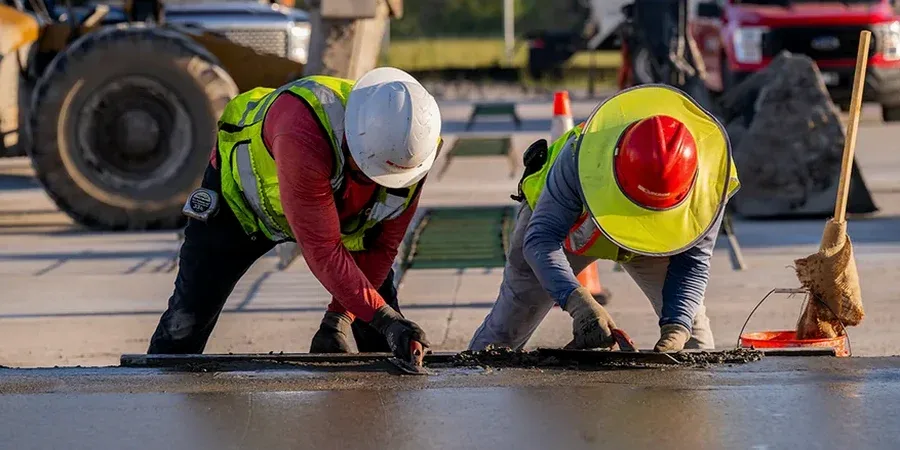
Typical technical challenges in Reno
Southeast Reno around Hidden Valley sits on older alluvial fan deposits with cobbles and boulders that give a false sense of bearing security, while the North Valleys near Stead are underlain by younger, finer lakebed silts with high collapse potential when wetted. A rigid pavement designed for one condition fails rapidly in the other. Slabs over the North Valleys’ silts develop pumping at transverse joints after just a few seasons of snowmelt infiltration, eroding the subbase and leaving dowel bars unsupported. In Hidden Valley, the risk is differential heave from expansive clay lenses that dome the slab between contraction joints. We reduce these risks by mapping the pavement support value across the entire pad with closely spaced dynamic cone penetrometer profiles, and by specifying geotextile separation layers where the subgrade fines are susceptible to migration into the open-graded drainage layer. Reno’s winter traction sand application accelerates joint spalling if the joint sealant reservoir isn’t detailed with backer rod at the correct depth.
Our services
Our rigid pavement design scope spans from subgrade investigation through joint detailing and construction-phase support. Every project involves three integrated work phases that ensure the concrete pavement performs for the full 30-year design life common in Reno’s warehousing sector.
Subgrade Characterization and k-value Determination
Plate load testing per ASTM D1196 on prepared subgrade and base layers, combined with resilient modulus correlations from DCP and Shelby tube sampling, to establish the modulus of subgrade reaction for AASHTO thickness design.
Jointing Plan and Reinforcement Detailing
Contraction joint layout with dowel baskets at transverse joints and deformed tie bars at longitudinal joints, sealant reservoir geometry per NDOT standard sheets, and reinforcing steel schedules for odd-shaped panels at dock aprons.
Mix Design Review and Flexural Strength Verification
Laboratory trial batches with local aggregate sources to confirm flexural strength, workability for slipform paving, and resistance to alkali-silica reaction given Reno’s reactive volcanic aggregates.
Common questions
What does rigid pavement design cost for a typical Reno warehouse project?
For a standard rigid pavement design package covering subgrade investigation, k-value determination, thickness design, joint plan, and construction support, budgets in Reno range from approximately US$1,770 for smaller pads up to US$6,100 for larger distribution centers with complex dock layouts and heavy forklift traffic. Each project is quoted individually after we review the geotechnical report and traffic data.
Do you follow AASHTO 93 or the newer MEPDG for Reno pavements?
We calibrate designs using both methods. AASHTO 93 remains the contractual standard referenced in most Nevada building permits, but we cross-check critical assumptions like climate input and axle load spectra through AASHTOWare Pavement ME Design (MEPDG) to model how Reno’s specific freeze-thaw cycles and diurnal temperature swings affect slab curl stresses over the design life.
How do you account for Reno’s freeze-thaw damage on concrete joints?
Joint durability starts with a low water-cement ratio mix and adequate air entrainment (5-7% per NDOT), but the real defense is in the joint sealant detail. We specify preformed compression seals or hot-pour sealant with a closed-cell backer rod set at exactly half the sealant depth, and we require joint reservoirs to be sawn within 12 hours of final set to control early-age cracking before the first winter.
Can you design a rigid pavement that handles heavy forklift traffic inside a warehouse?
Yes. Racking aisle pavement is designed as a separate structural element from the free-movement slab. We increase slab thickness locally under rack legs, tighten joint spacing to 12 feet to reduce curl stress, and specify steel fiber reinforcement in the concrete mix to improve post-crack toughness under the concentrated, repetitive loads from narrow-aisle reach trucks and counterbalance forklifts.