ASCE 7 and the IBC demand rigorous subsurface investigation before any tunneling work begins. In Reno, the challenge is unique. The city sits on the Truckee Meadows basin fill, where Quaternary alluvial deposits and interbedded lacustrine clays create a soft ground profile that complicates tunnel boring. Our geotechnical analysis for soft soil tunnels targets the specific parameters needed for tunnel face stability and settlement prediction. We run consolidated-undrained triaxial tests on undisturbed Shelby tube samples to get effective stress parameters. Index properties alone won't cut it. For TBM design in these conditions, the grain size distribution and plasticity characteristics drive the selection of conditioning agents and cutterhead torque calculations. Every project we handle starts with a testing plan tailored to the local stratigraphy, not a generic checklist. The basin's fine-grained soils, deposited during Pleistocene Lake Lahontan cycles, often show unexpected compressibility that standard penetration tests miss entirely. You need a lab that understands the link between the Atterberg limits and the slurry pressure window needed to keep the face stable under Virginia Street or the railroad corridor.
Stability in Reno's basin fill depends on effective stress parameters from CIU triaxial tests, not just SPT blow counts.
Service characteristics in Reno
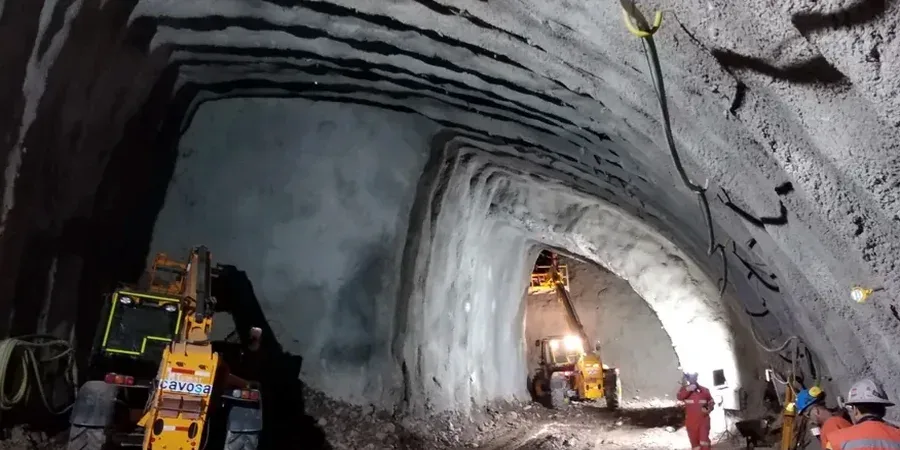
Typical technical challenges in Reno
A tunnel drive under the Reno-Sparks industrial area hit a pocket of loose saturated silt lens just 15 feet below the rail tracks. The face became unstable within minutes. No blowout, but the settlement trough extended 60 feet east of the centerline, cracking a warehouse slab. The root cause was clear. The pre-bid investigation relied solely on SPT data from 50-foot spacing. It missed the lens entirely. Our geotechnical analysis for soft soil tunnels closes that gap. We map the undrained shear strength profile continuously via CPT correlation and verify with triaxial testing on targeted samples. The risk in Reno isn't just face loss. It's the post-construction consolidation settlement in the compressible clays that takes years to manifest. Without a properly defined Cc and Cv from oedometer tests, the long-term settlement under the groundwater drawdown zone is unpredictable. A CPT test program identifies these thin, problematic layers that standard borings skip right through. We've seen too many change orders and emergency grouting projects that started with a sparse site investigation. The basin's soil variability demands a testing density that matches the complexity of the ground.
Our services
Our lab program is built around the parameters that directly influence TBM operation and lining design in Reno's basin environment.
Tunnel Face Stability Soil Testing
We run CIU triaxial and direct shear tests to define the failure envelope for fine-grained Truckee Formation soils. Includes grain size analysis and Atterberg limits to predict soil-clogging potential in the cutterhead.
Settlement Prediction and Monitoring Analysis
One-dimensional consolidation tests provide Cc, Cr, and Cv for accurate settlement trough modeling. We correlate lab results with field CPT data to identify compressible lenses that threaten surface structures.
Common questions
What lab tests are critical for soft ground tunneling in Reno's basin fill?
CIU triaxial tests for effective stress parameters and undrained shear strength. Consolidation tests for settlement prediction. Atterberg limits and grain size distribution to assess clogging potential and soil conditioning needs. Bender element tests for small-strain stiffness if building damage assessment is required.
What is the typical cost range for a soft ground tunnel geotechnical analysis in Reno?
A complete lab testing program for soft ground tunnel analysis in Reno typically ranges from US$3,610 to US$18,520. The final cost depends on the number of samples, the testing suite required, and whether advanced tests like bender elements or cyclic triaxial are needed.
How do you handle the interbedded silt and clay layers common in the Truckee Meadows?
We sample each distinct layer separately. Shelby tubes capture the clay, and piston sampling handles the silts. We avoid composite samples. Each layer gets its own consolidation and triaxial test. This prevents mixing a stiff silt with a soft clay and getting an averaged, misleading parameter that underestimates settlement.
Which ASTM standards do you follow for tunnel design parameters?
We follow ASTM D4767 for consolidated-undrained triaxial compression, ASTM D2435 for one-dimensional consolidation properties, ASTM D2487 for soil classification, and ASTM D4318 for Atterberg limits. All testing adheres to the requirements of ASCE 7 and the IBC for subsurface investigation programs.