Reno's expansion from a railroad town into a high-desert tech hub has placed new demands on its subsurface. The Truckee River deposited layers of silts, sands, and cobbles across the valley floor, while the surrounding alluvial fans hide lenses of expansive clay and undocumented fill. A soil mechanics study here is not a formality; it is the data set that separates a stable slab from a cracked one. We run index and strength tests under ASTM D2487 and ASTM D1586 protocols, producing parameters that structural engineers can use directly. For deep foundations near the river corridor, we often pair the triaxial data with settlement predictions, and for sites in older industrial zones, we check gradation with a grain-size analysis to rule out collapsible silts. The goal is to give the design team a clear picture of what lies beneath before concrete is poured.
A single consolidation test on a Shelby tube sample can save more in foundation concrete than the entire geotechnical investigation budget.
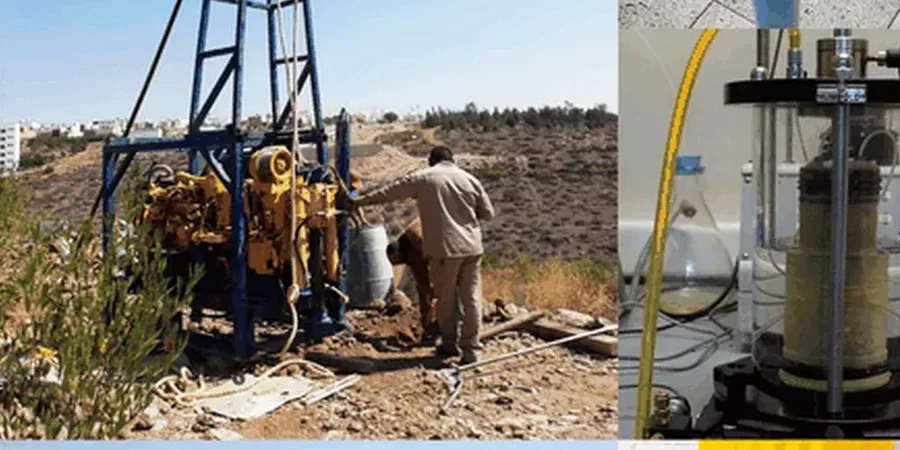
Service characteristics in Reno
Demonstration video
Typical technical challenges in Reno
A common mistake we see in Reno is treating the upper 5 feet of sandy silt as a uniform bearing stratum without checking for loose zones. A footing placed on an uncompacted fill pocket, left over from a 1970s subdivision, will settle differentially within the first two wet seasons. The repair costs dwarf the price of a proper soil mechanics study. We have pulled samples near McCarran Boulevard where the blow count dropped from 18 to 5 across a single 2-foot interval—clean evidence of a buried trash pit. Skipping the lab phase and relying on field logs alone is a gamble. Consolidation settlement in the Truckee Meadows silts can take years to fully develop, and once the framing is up, underpinning is the only fix. The IBC requires a geotechnical report for all structures; doing it right means testing, not just classifying.
Our services
Our soil mechanics study covers the full chain from sampling to parameter selection. We work with local drilling subcontractors we have vetted over dozens of projects in Washoe County. Each service below feeds directly into the foundation design report.
Index and Classification Testing
Atterberg limits, sieve and hydrometer analysis, and USCS classification per ASTM D2487. We determine the soil type before strength testing begins.
Shear Strength and Consolidation
Direct shear, triaxial, and one-dimensional consolidation tests. We deliver effective stress parameters and compressibility curves for shallow and deep foundations.
Expansive Soil Evaluation
Expansion index and swell-consolidation tests for the upper strata. Critical for slab-on-grade construction in Reno's clay lenses south of the airport.
Seismic Site Classification
Vs30 estimation via SPT correlation or MASW survey. We assign the ASCE 7 site class, which directly affects the seismic base shear used in structural design.
Common questions
What is the typical cost of a soil mechanics study in Reno?
For a standard commercial lot with 2 to 3 borings and a full lab suite, the budget usually falls between US$3,480 and US$5,620. The final figure depends on depth, number of samples, and whether we need specialized tests like triaxial or consolidation.
How deep do you drill for a soil mechanics study in the Truckee Meadows?
Most commercial projects require borings to 30 or 40 feet, or until we hit competent natural ground. If deep foundations are on the table, we go deeper—often 60 to 80 feet—to characterize the bearing stratum and check for cobble layers that can stop pile driving.
How long does the lab testing phase take?
Index tests turn around in 3 to 5 business days. Consolidation and triaxial tests need longer, typically 10 to 14 working days, because of the staged loading and pore-pressure equalization required by ASTM D2435 and D4767.
Do you provide foundation recommendations with the soil mechanics report?
Yes. The report includes allowable bearing capacity, anticipated settlement, spring constants for mat design, and lateral earth pressure coefficients for retaining walls. We write it so the structural engineer can plug the numbers directly into their model.