Reno sits at 4,505 feet above sea level, nestled in the Truckee Meadows basin where the subsurface hides layers of unconsolidated alluvial sediments deposited by the Truckee River over millennia. Construction here routinely encounters loose sands, silts, and soft clays that complicate foundation design, especially with the city's Seismic Design Category D classification under ASCE 7. Stone column design offers a proven ground improvement strategy to densify these problematic deposits, increase bearing capacity, and mitigate liquefaction potential. When a CPT test reveals tip resistances below 50 tsf in the upper 20 feet, we configure stone column grids that transfer structural loads to competent strata while providing drainage paths that reduce pore pressure buildup during seismic events. The approach works particularly well in the industrial corridors east of downtown where recent warehouse developments have encountered compressible layers at shallow depth.
In Reno's alluvial basin, stone columns do double duty: they carry structural loads and act as vertical drains that dissipate seismic pore pressure before liquefaction can trigger.
Service characteristics in Reno
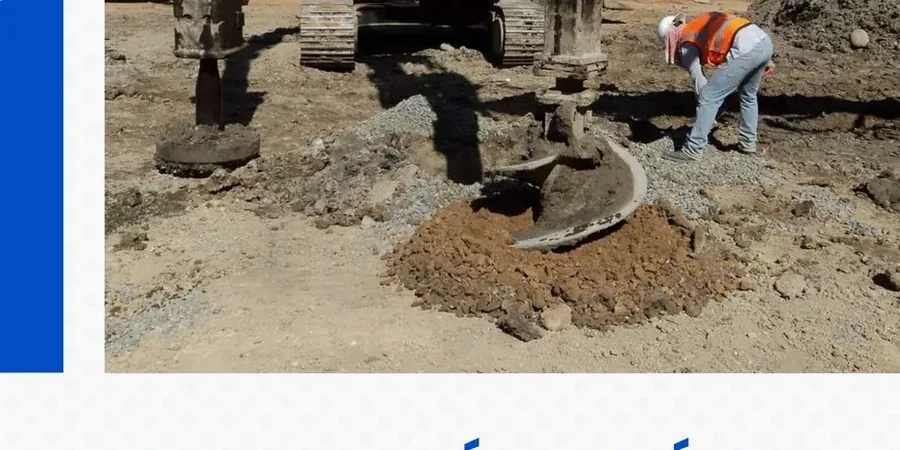
- Vibro-replacement columns installed to depths of 15 to 45 feet through weak alluvium
- Area replacement ratios ranging from 10% to 35% depending on target bearing capacity
- Aggregate gradation specified per ASTM D448 with stone sizes optimized for local Truckee River cobble sources
- Post-installation verification through modulus load tests and cross-hole seismic surveys
Demonstration video
Typical technical challenges in Reno
The Truckee Meadows basin contains extensive deposits of Holocene-age loose sands with groundwater as shallow as 6 to 10 feet in areas near the river, creating ideal conditions for seismically-induced liquefaction. Without stone column treatment, these saturated granular layers can lose all shear strength during a design-level earthquake, transforming foundation soils into a fluid mass incapable of supporting structures. The 2008 Mogul earthquake sequence, though moderate at magnitude 5.0, produced localized ground failures in the western Reno suburbs that underscored the vulnerability of untreated alluvial soils. Stone columns provide a dual mechanism of protection: the vibro-replacement process densifies the surrounding soil through displacement and vibration, while the column itself creates a stiff inclusion that attracts shear stress away from the liquefiable matrix. For critical facilities, we combine column grids with the principles outlined in Seed and Ibiss's liquefaction assessment framework to confirm that factor of safety exceeds 1.3 under the Maximum Considered Earthquake.
Our services
Our Reno office provides comprehensive stone column design integrated with site characterization and verification testing for projects across Washoe County.
Stone Column Grid Design
Full design of triangular and square column patterns using Priebe and finite element methods, including settlement analysis and bearing capacity verification for column-supported footings and embankments.
Liquefaction Mitigation Analysis
Evaluation of liquefaction susceptibility using CPT and SPT data, with stone column layouts calculated to achieve target factor of safety under ASCE 7 seismic loading.
Post-Installation Verification
Modulus load testing and cross-hole seismic surveys to confirm column stiffness and continuity, ensuring the as-built ground improvement meets design specifications.
Common questions
What does stone column design cost for a Reno project?
Stone column design fees for Reno projects typically range from US$1,300 to US$6,010, depending on the project size, number of column locations, and whether liquefaction analysis is required. A small commercial building pad with straightforward soil conditions falls at the lower end, while a large warehouse with extensive CPT data and seismic modeling will be at the higher end. We provide a fixed-fee proposal after reviewing the geotechnical report and site plans.
How deep do stone columns need to go in Reno's soils?
Depth depends on the thickness of the weak layer identified in the geotechnical investigation. In the Truckee Meadows basin, we commonly install columns to depths between 15 and 45 feet to penetrate through loose alluvial sands and reach competent gravels or hard clay. The specific depth is determined after reviewing CPT or SPT profiles and evaluating the liquefaction-susceptible zone thickness.
What soil types in Reno are suitable for stone columns?
Stone columns work best in Reno's loose sands and silty sands with fines content below 15%. Soils with higher silt or clay content may require modified installation techniques or alternative ground improvement methods. We evaluate grain size distribution and plasticity characteristics from laboratory testing before recommending stone columns, as cohesive soils above a certain plasticity threshold do not densify adequately through vibro-replacement.
How do you verify that stone columns are working after installation?
We specify a combination of modulus load tests on individual columns and cross-hole seismic surveys between columns to measure shear wave velocity improvement. The load test confirms stiffness and capacity, while the seismic survey maps the extent of densification in the surrounding soil. For liquefaction-critical sites, we may also run post-treatment CPT soundings to document the increase in tip resistance and confirm the design factor of safety has been achieved.