Reno sits at 4,500 feet where decomposed granite and floodplain silts alternate across the Truckee Meadows. The diurnal temperature swings—often 40°F in a single day—and the basin’s complex alluvial stratigraphy mean that shear strength can shift dramatically within a single borehole. Standard penetration data alone won’t tell you how the soil behaves under sustained load or rapid drawdown. That’s where the triaxial test becomes the definitive tool. Our lab runs consolidated-undrained (CU) and drained (CD) stages on undisturbed Shelby tube samples, giving project engineers the effective stress parameters—c’ and φ’—needed to size footings, design retaining walls, and evaluate slope stability near the Virginia Range foothills. In a city where the water table can rise 15 feet between August and March, pore pressure response measured in the triaxial cell is not academic—it is what keeps a basement dry and a foundation uncracked.
Effective cohesion in Reno’s basin silts often drops below 100 psf once the sample is saturated and sheared—relying on undrained SPT correlations alone is a gamble.
Service characteristics in Reno
Typical technical challenges in Reno
In Reno, many geotechnical reports still lean on correlated friction angles from N-values when the basin stratigraphy demands direct measurement. The problem shows up where Truckee River floodplain deposits—interbedded silts and loose sands—are treated as uniform material. A triaxial test on an undisturbed sample will often expose a contractive response, meaning the soil loses strength as it shears, a condition that SPT blow counts completely miss. If your foundation design uses a friction angle of 32° based on correlation but the real drained φ’ is 26°, the bearing capacity factor Nγ drops by more than half. For a mat foundation under a four-story medical office building, that error translates into settlement exceeding 2 inches and differential movement that cracks partition walls. The triaxial test also identifies cementation from calcium carbonate common in older alluvial fans east of Sparks. That cementation boosts cohesion temporarily but dissolves with prolonged saturation, a mechanism only visible when you compare peak and residual strength envelopes from a multi-stage test.
Our services
Our Reno laboratory runs triaxial programs integrated with the full geotechnical investigation cycle. We coordinate directly with the drilling crew to minimize sample disturbance and schedule testing to match your design milestones.
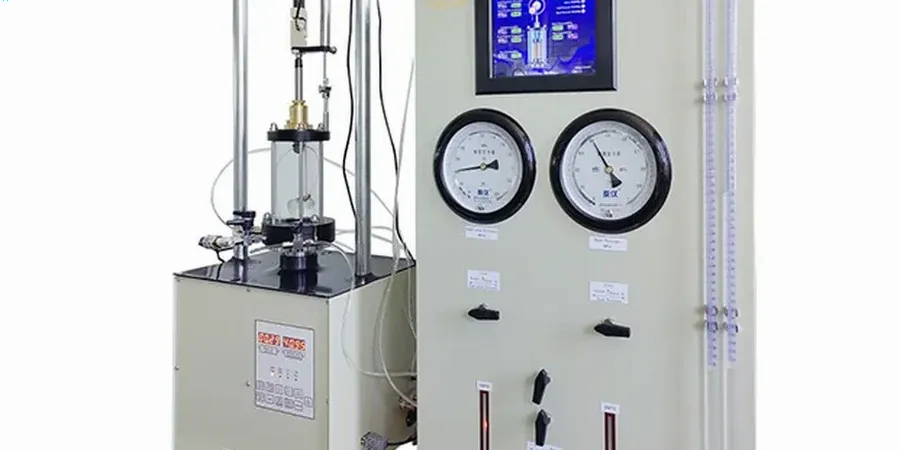
Consolidated-Undrained (CU) Triaxial with Pore Pressure
Three-stage CU test with back-pressure saturation and pore pressure measurement, suitable for foundation and slope design in saturated Truckee Meadows silts and clays. Includes Mohr-Coulomb envelopes in effective and total stress.
Consolidated-Drained (CD) Triaxial for Long-Term Conditions
Slow shearing at 0.002–0.005 in/min to allow full drainage, giving true drained parameters for retaining wall design, excavation analysis, and settlement prediction in free-draining decomposed granite soils.
Common questions
How much does a triaxial test program cost in Reno?
A standard three-stage CU triaxial test on one undisturbed sample typically runs between US$1,610 and US$2,430 in the Reno market, depending on the number of confining stages and whether you need a CD companion test. A project with three boreholes and two triaxial specimens per borehole will generally fall in the US$9,500–US$14,500 range for the lab component. We provide a fixed-price quote before any work begins so you can lock in the geotechnical budget early in the design phase.
When does a triaxial test become mandatory under IBC and local Reno requirements?
IBC 2021 Section 1803 kicks in triaxial testing whenever the foundation design relies on shear strength parameters rather than presumptive bearing values, which covers most commercial projects over two stories in Reno. The City of Reno Building Department also expects direct shear testing or triaxial data when you propose mat foundations, deep excavations over 12 feet, or slopes steeper than 2:1 near structures. For seismic site classification per ASCE 7-22, triaxial data on fine-grained soils below the groundwater table is the only way to determine undrained shear strength for Site Class E and F evaluations.
How do you handle sample disturbance when the soil in Reno is often partially saturated?
We require Shelby tubes sealed with microcrystalline wax at both ends immediately after extrusion on the rig. In the lab, we x-ray each tube before opening to identify disturbed zones and select trimming locations. For partially saturated silts common in the Lemmon Valley area, we apply back-pressure saturation in the triaxial cell while monitoring Skempton’s B-value; we do not start the consolidation stage until the B-value exceeds 0.95. This process can add 24–48 hours to the test schedule but is essential for reliable effective stress paths.
Can you run triaxial tests on granular soils from Reno’s alluvial fans?
Yes, but it requires careful specimen preparation. Coarse decomposed granite from the Peavine Mountain fans often contains particles up to 1 inch, so we first run a parallel grain-size analysis per ASTM D6913 to check if the maximum particle size exceeds one-sixth of the specimen diameter. If it does, we scalp the material and reconstitute at field density for a drained CD test. For clean sands below the Truckee River channel, we use the moist tamping method to achieve relative density targets and run CD tests at confining pressures matching the design depth.