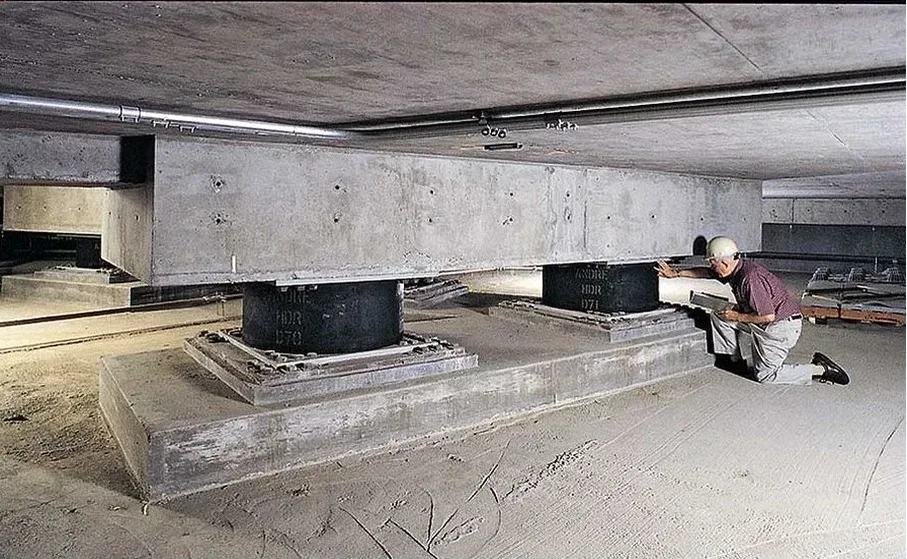
Reno sits in a basin between mountain ranges. The air is dry. The soil shifts with freeze-thaw cycles and sudden snowmelt runoff from the Sierra Nevada. These desert conditions mask a deeper threat: the Walker Lane fault system runs right through western Nevada. We see older masonry buildings downtown that predate modern codes. They are vulnerable. Newer high-rises need protection too. Base isolation seismic design decouples a structure from ground motion. It is not a one-size-fits-all solution here. The local geology demands a site-specific approach. We often pair the isolator analysis with a seismic microzonation study to map how the basin fill amplifies shaking in different neighborhoods. This data feeds directly into the bearing selection. The goal is a system that works when the dry lakebed sediments resonate during a rupture.
In Reno's basin, the biggest risk is not just the fault rupture but the amplification of long-period waves through 300 feet of sedimentary fill.
Service characteristics in Reno
Typical technical challenges in Reno
Reno grew fast after the 1930s gaming boom. Buildings went up along the Truckee River corridor. Many sit on alluvial deposits that liquefied during past events. The 2008 Mogul earthquake swarm reminded everyone: the ground here is restless. A base isolation seismic design failure would be catastrophic. Not just structural collapse. Loss of essential hospital function post-quake. Rupture of gas lines in isolated hotels. We model the near-fault pulse effects from the Mt. Rose fault system. These pulses can cause large velocity shocks. Standard isolation systems can drift beyond their moat walls if the pulse period aligns with the isolated structure's period. We check this with nonlinear time-history analysis using site-specific ground motion pairs. The arid climate creates another problem. The isolation plane must resist fine dust intrusion. We specify a continuous elastomeric skirt and a pressurized moat cover system.
Our services
Our work in Reno integrates the isolation design with the geotechnical reality of the site. We do not just hand over a bearing schedule. We ensure the foundation and the soil can handle the concentrated loads from the isolators.
Nonlinear Time-History Analysis for Isolated Structures
We build a full 3D model in ETABS or SAP2000. We input 11 pairs of scaled ground motions. The analysis captures uplift, torsion, and moat impact. Every isolator is modeled with its actual hysteretic loop.
Full-Scale Prototype Testing Oversight
We write the test protocol per ASCE 7. We witness the tests at the manufacturer's lab. We review the force-displacement loops for stability, damping, and scragging effects.
Common questions
What is the typical cost range for a base isolation seismic design project in Reno?
For a mid-rise structure in Reno, the design and analysis phase typically ranges from US$4.090 to US$8.140. This covers the full nonlinear time-history analysis, the isolator specification report, and the peer review coordination. It does not include the isolator hardware cost or the construction of the isolation plane.
How does the Walker Lane fault system affect the isolator design?
The Walker Lane is a zone of distributed shear. It produces shallow crustal earthquakes with strong vertical components. Our ground motion models account for the hanging-wall effect and the directivity pulse. We often need to increase the isolator's vertical stiffness to manage the uplift forces.
Do you use Friction Pendulum Systems (FPS) or elastomeric bearings in Reno?
We evaluate both. FPS bearings self-center after the earthquake. They work well on stiff soil sites. Elastomeric bearings with lead cores absorb more energy. In Reno's basin fill, we often lean toward triple pendulum systems. They adapt their stiffness as the shaking intensifies.
How do you verify the isolation system works before construction?
We require full-scale prototype testing of every isolator type. The test rig applies the design displacement for ten cycles. We check for stiffness degradation. We also test the isolator at the MCER displacement. Then we test the stability under the maximum considered load. All results are sealed by the engineer of record.