We recently worked on a commercial project near the Tahoe-Reno Industrial Center where the grading contractor hit pockets of fine-grained sediment that simply would not compact. The material felt greasy underfoot after a light rain — a classic sign of high-plasticity clay. In our experience across the Truckee Meadows, these silty-clay layers, deposited by ancient Lake Lahontan, can completely derail a construction schedule if not identified early. That is where Atterberg limits testing becomes indispensable, defining the moisture contents at which the soil transitions from brittle solid to plastic, and from plastic to liquid. For projects spanning from downtown Reno high-rises to retaining structures near the Virginia Range, we run these tests to assign the correct USCS group symbol and predict shrink-swell behavior before foundations go in.
A plasticity index above 20 in Reno's lacustrine soils changes the entire foundation strategy — from standard footings to a stiffened slab or deep foundation system.
Service characteristics in Reno
Typical technical challenges in Reno
The semi-arid climate of Northern Nevada creates a deceptive risk: soils that test as low-plasticity in the dry summer can exhibit dramatically different behavior when saturated during spring snowmelt. We have seen foundation movement in Spanish Springs where the geotechnical report relied solely on grain-size distribution without running Atterberg limits, missing a thin, highly plastic clay seam that softened and consolidated under the footing load. The biggest liability in Reno is not the granite bedrock of the Sierra Nevada foothills — it is underestimating the volume change potential of the fine-grained basin fill. ASTM D4318 data, interpreted through the Casagrande plasticity chart, provides the threshold criteria for classifying a soil as potentially expansive, allowing the design team to specify moisture-conditioned fill or alternative foundation types before the first yard of concrete is poured.
Our services
Our Reno laboratory provides a complete suite of index property testing that supports geotechnical investigations from preliminary site characterization through construction quality assurance.
Full Atterberg Limits (LL, PL, PI)
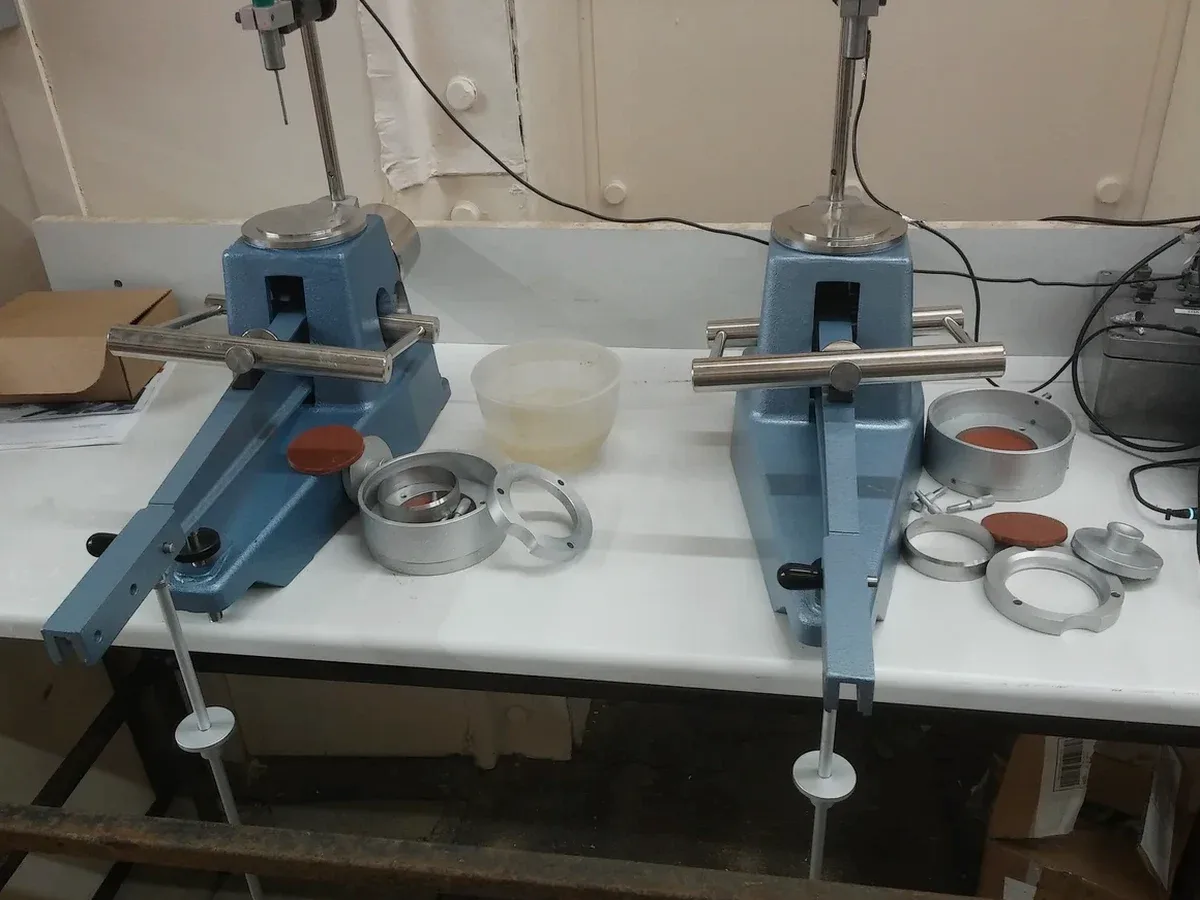
Multi-point liquid limit using the Casagrande cup, plus plastic limit determination via the standard 3 mm thread method. We report the plasticity index and USCS classification per ASTM D2487, with same-week turnaround for routine projects in Washoe County.
One-Point Liquid Limit (Routine QC)
For earthwork compaction control where the soil type is already established, we run the one-point method to verify that borrow source material has not changed plasticity during excavation. This is common for large grading operations in Stead and Cold Springs.
Shrink-Swell Potential Assessment
Using the plasticity index and correlation charts from Holtz & Kovacs, we provide a qualitative expansion potential rating — low, medium, high, or very high — to guide foundation design in Reno's expansive clay zones.
Common questions
What does the Atterberg limits test actually measure?
It measures the moisture contents at which a fine-grained soil changes consistency states. The liquid limit is the water content where the soil flows under 25 blows in a Casagrande cup. The plastic limit is where a 3 mm thread crumbles. The plasticity index — the numerical difference between the two — tells us how much water the soil can absorb while remaining plastic, which is a direct indicator of clay mineral activity and shrink-swell potential.
How much does Atterberg limits testing cost for a Reno project?
For a standard multi-point Atterberg limits test (liquid limit and plastic limit) on a single sample, the fee ranges from US$70 to US$110 depending on sample preparation time and whether we need to wash the material through a No. 40 sieve. Rush testing with 24-hour turnaround is available at a premium for construction-critical decisions.
Why can't we just use grain-size analysis instead of Atterberg limits?
Grain-size distribution tells you the proportion of sand, silt, and clay by weight, but it says nothing about the mineralogy or electrochemical activity of the clay fraction. Two soils with identical grain-size curves, one derived from kaolinite and the other from montmorillonite, will have completely different plasticity and expansion behavior. Atterberg limits capture this mineralogical difference, which is essential for foundation design in Reno's lacustrine deposits. More info.